

Public office is not a desk job with fixed hours. Legislative sessions, committee work, constituency meetings, and travel can fill a calendar months in advance, and the appointments easiest to postpone are the ones without an immediate deadline. Routine health checks tend to be exactly those. For men over 60, who make up a substantial share of elected and appointed officials in many countries, that habit collides with the age range in which prostate cancer is most commonly diagnosed.

Why a packed political calendar works against preventive care
Deferring a checkup is rarely one decision. It is a series of small ones: a session runs late, a flight is rescheduled, a town hall takes priority. Over a term in office, those choices compound, and preventive appointments – screening, blood tests, follow-ups – drift behind visible, deadline-driven work.
Public officials rarely work to a predictable calendar, and the pressure is familiar wherever legislative business moves quickly. That pattern shows up in fast-moving political environments, a dynamic that Southeast Asian political coverage frequently illustrates. The health takeaway is straightforward: the busier the schedule, the more deliberately time for screening has to be protected rather than left to chance.
What the numbers say about prostate cancer after 60
Prostate cancer is the most common cancer among men in the United States after skin cancer, and age is its strongest risk factor. The American Cancer Society estimates roughly 333,830 new U.S. diagnoses and 36,320 deaths in 2026. About 1 in 8 men will be diagnosed during their lifetime, roughly 6 in 10 cases are found in men aged 65 or older, and the average age at diagnosis is about 67.

Two figures shape most of the screening debate. Prostate cancer found while still confined to the prostate is associated with very high long-term survival; cancer that has already spread is not. That gap is why the method and timing of detection carry so much weight.
| Stage at diagnosis | 5-year relative survival | 10-year relative survival |
|---|---|---|
| Localized (confined to the prostate) | More than 99% | 100% |
| Regional (spread to nearby structures or lymph nodes) | More than 99% | 96.1% |
| Distant (spread to other parts of the body) | 38% | 18.5% |
| All stages combined | 98% | 97.2% |
Sources: 5-year relative survival from the American Cancer Society, based on the National Cancer Institute SEER database for men diagnosed 2015–2021; 10-year relative survival from CDC analysis of U.S. Cancer Statistics for men diagnosed 2001–2016. Figures are population estimates, not predictions for any individual.
The striking part is the distance between the first row and the third. Those figures describe groups, not individuals, and they reflect people diagnosed several years ago. Even so, the pattern is consistent: stage at diagnosis is among the strongest factors in the outcome.
What “a prostate exam” actually involves now
The phrase “prostate exam” often brings a digital rectal exam to mind, and that mental image can itself be a reason men avoid screening. The evidence has moved, though. Major guidelines now treat a PSA blood test as the first-line screening tool, and the digital rectal exam is no longer recommended as a standalone screening test. The U.S. Centers for Disease Control and Prevention notes there is no single standard screening test; PSA is the main blood test used, and results need a clinician’s interpretation because age, infection, an enlarged prostate, and some medications can all affect the reading.
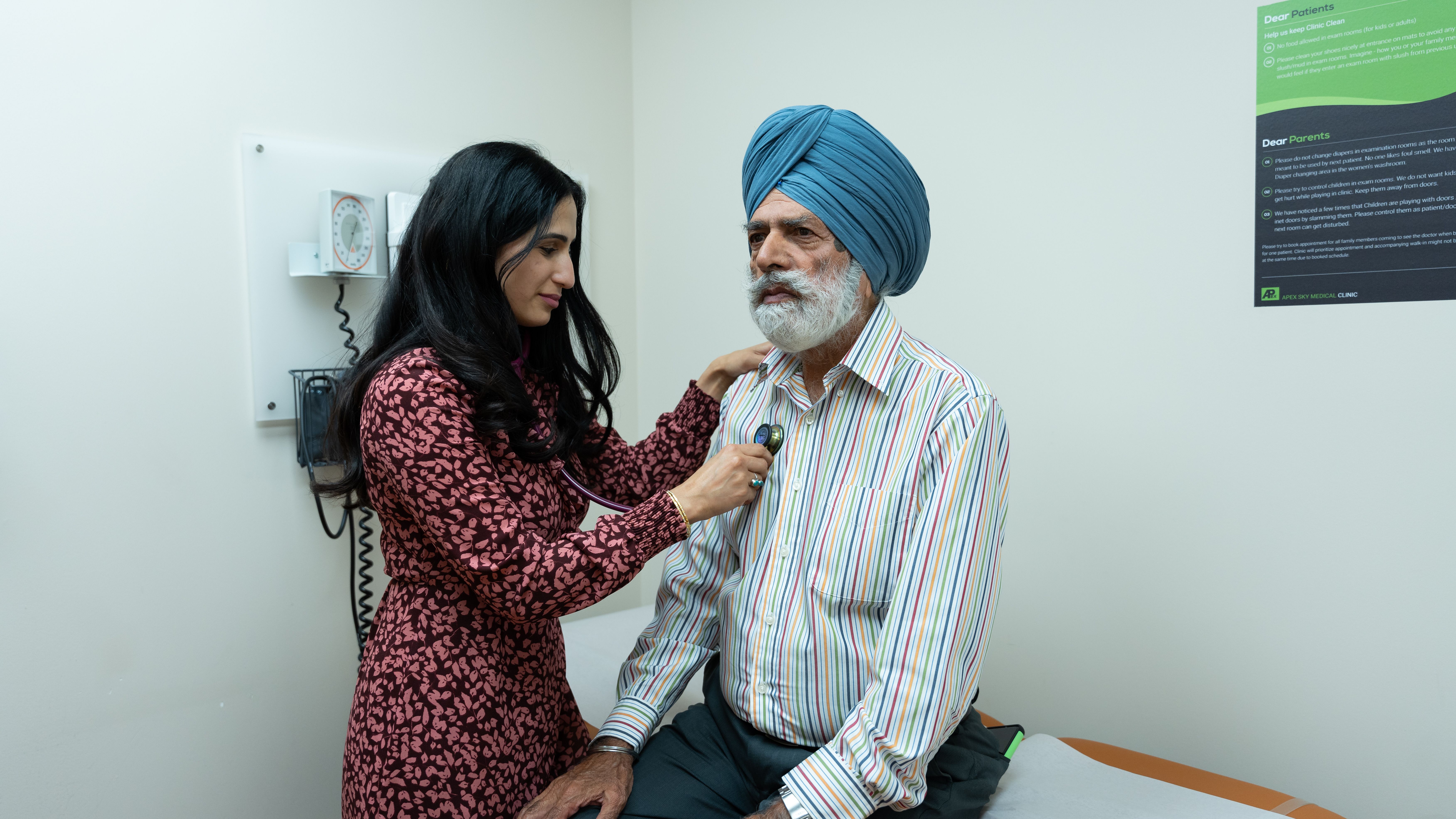
Several practical details are worth knowing before a first test:
- PSA is a screening test, not a diagnosis. An elevated result does not mean cancer is present. Benign enlargement, inflammation, urinary tract infection, and recent procedures can all raise the number.
- A repeat test is often the next step. PSA has a half-life of roughly two to three days, and clinicians typically repeat a newly elevated PSA before ordering imaging or a biopsy.
- Thresholds shift with age. Because PSA tends to rise with age in men without cancer, commonly cited reference points run higher for older men – around 4.5 ng/mL for men in their 60s – while the same number would be more concerning in a man in his 40s.
- MRI increasingly sits between a high PSA and a biopsy. Multiparametric MRI is used to decide whether a biopsy is needed and to guide sampling if one is.
- Only a biopsy confirms cancer. Imaging and blood tests estimate risk; a tissue sample is what establishes a diagnosis and its grade.
Where the guidelines get uncomfortable
Here is the part that a headline promising “never skip” tends to flatten. The guidance is not identical across age groups, and it is not identical across organizations.
The 2026 amendment to the American Urological Association and Society of Urologic Oncology guideline recommends regular screening every two to four years for people aged 50 to 69 at average risk, a strong recommendation supported by randomized trial evidence. It also allows a baseline PSA in the mid-40s, earlier screening for those at higher risk, and personalized intervals for older men. For men 75 and older with a PSA below 3 ng/mL, clinicians may lengthen the interval or discontinue screening.
The U.S. Preventive Services Task Force takes a more cautious line. Its prostate cancer screening recommendation classifies the decision for men aged 55 to 69 as an individual one, best made after discussing benefits and harms, and recommends against routine screening for men 70 and older. It points to potential harms including false positives that lead to further testing or biopsy, overdiagnosis and overtreatment, and treatment complications such as incontinence and erectile dysfunction. Drawing on longer follow-up of a large European trial, the Task Force estimates that PSA screening prevents about 1.28 deaths from prostate cancer per 1,000 men screened over an extended period, and that overdiagnosis may occur in 20% to 50% of screen-detected cancers.

The counterweight is that many prostate cancers grow slowly. The National Cancer Institute has reported that the prevalence of clinically indolent tumors – cancers that would not go on to cause harm – is estimated at 30% to 70% in men older than 60, based on autopsy series of men who died of unrelated causes. For a man in his late 70s or 80s with other health conditions, detecting such a tumor can lead to treatment that reduces quality of life without extending it.
This is a genuine disagreement among expert bodies, not a settled question. The American Academy of Family Physicians and the Canadian Task Force on Preventive Health Care have both recommended against PSA-based screening, while the Prostate Cancer Foundation advises healthy men over 70 to keep discussing screening with a doctor. The National Comprehensive Cancer Network, for its part, suggests screening past 75 only for very healthy people expected to live another 10 or more years.
The practical implication for a man over 60 in public office is that the decision is age-sensitive and health-sensitive. For men in their 60s with a reasonable life expectancy and no serious competing illness, PSA screening is a defensible, evidence-supported choice. Past 70, the balance turns on life expectancy, other conditions, prior PSA results, and personal preference – which is an argument for a conversation rather than a fixed rule in either direction.
Shared decision-making: what the conversation should cover

Every major guideline reviewed for this article recommends shared decision-making: a discussion in which the clinician explains risk and the patient’s values shape the choice. A useful conversation generally covers the person’s age and overall health, family history of prostate or related cancers, prior PSA values and their trend, the possibility of a false positive, what a biopsy involves, and how a diagnosis might be managed – including active surveillance, which monitors low-risk cancer rather than treating it immediately.
For an officeholder, one additional practical point: continuity of care matters more than the venue. A PSA measured in one city has limited value if the next one is taken elsewhere with no record to compare against. Keeping results with a primary care physician, or at least carrying a simple history, makes the trend readable and the decision better informed.
A practical approach for men over 60 in public office
- Know your baseline. A conversation about screening is easier when there is a prior PSA value to compare against. Men in their 60s who have never been tested are often starting from zero.
- Schedule around the calendar, not after it. Blocking a medical appointment before a session period or travel cycle begins lowers the odds it gets deferred indefinitely.
- Separate the tests. The PSA blood draw is quick; a digital rectal exam and any follow-up imaging are separate decisions, and a clinician can explain whether they are needed in a given case.
- Ask what a positive result would trigger. Knowing in advance whether an elevated PSA would mean a repeat test, an MRI, or a biopsy reduces uncertainty and panic.
- Revisit the decision as health changes. Life expectancy and other conditions weigh heavily after 70, and a plan that fit at 62 may not fit at 78.
Frequently asked questions
At what age should prostate cancer screening begin?
Expert groups differ, but a common approach is to discuss screening with a clinician starting around age 45 for men at average risk, and around age 40 for those at higher risk, such as Black men or men with a strong family history. The American Urological Association notes that screening may begin with a baseline PSA between ages 45 and 50.
Is a digital rectal exam still required for prostate screening?
No. Most current guidelines do not recommend a digital rectal exam as a standalone screening test. Where one is performed, it is generally used alongside a PSA result rather than instead of it. Some clinicians still offer it, and some prefer MRI when further evaluation is needed.
Does a high PSA mean I have prostate cancer?
No. PSA can rise for reasons unrelated to cancer, including benign prostate enlargement, infection, or recent procedures. A high result signals the need for further evaluation, which is usually a repeat test before anything more invasive.
Should men over 70 still be screened?
Guidance varies. The U.S. Preventive Services Task Force recommends against routine screening for men 70 and older, while the American Urological Association and the National Comprehensive Cancer Network allow it for healthy older men with a long life expectancy, decided case by case. Prior PSA levels and overall health are central to the decision.
How often is screening usually repeated?
For men aged 50 to 69 at average risk, guidelines commonly suggest an interval of two to four years. Shorter intervals are often used for men with risk factors or a rising PSA, and longer intervals or discontinuation may be appropriate for older men with low PSA values.
How this article was put together
This piece set out to answer what the evidence and major guidelines actually say about prostate cancer screening for men over 60, including those in public office. It draws on the 2026 AUA/SUO early detection guideline, the U.S. Preventive Services Task Force recommendation, CDC screening and cancer-statistics material, American Cancer Society estimates for 2026, the National Cancer Institute’s treatment summary, and the 2026 NCCN patient guidance on prostate screening, all consulted in September 2026. Where expert bodies disagree – particularly about men over 70 – the disagreement is stated rather than resolved. Survival figures are population estimates from periods noted under the table and will be updated as new registry data are released. This article is general information and not medical advice; screening decisions are individual and belong with a qualified clinician.
For men over 60 in public office, the honest summary is not that a prostate exam should never be skipped. It is that the decision deserves a date on the calendar and a conversation with a physician – before a demanding schedule makes it for you.